Understanding the Course Layout
The normal golf game map matters because the course is not a linear set of fairways. It is one large, explorable space where landmarks, obstacles, story objectives, and bounties overlap. Learning to navigate it turns frustrating searches into deliberate shots.
Normal Golf Game places the player on a huge golf course that doubles as a playground and a trap. You can golf from many positions and hit far more than flags, so the best route is often determined by your current objective rather than the nearest hole.
| Map element | Why it matters | Best use |
|---|---|---|
| Tee boxes and flags | Mark conventional golf progression | Use them as reliable orientation points |
| Elevated terrain | Improves visibility and shot lines | Scout distant targets before committing |
| Large props | Often serve as memorable reference points | Match them to bounty descriptions |
| Signs and structures | Can be interactive objectives | Check whether they can be struck or broken |
| Bunkers and greens | Support location-based challenges | Practice landing control and recovery shots |
Do not treat every distant object as scenery. The course includes unusual targets, including oversized objects and hidden points of interest. If a bounty sounds strange, look beyond the fairway rather than assuming it refers to a standard golf feature.
A useful way to orient yourself is to identify one nearby landmark, one elevated location, and the direction of the closest visible flag. That gives you enough information to return after experimenting with a difficult shot.
How to Navigate Between Objectives
Walking and golfing serve different purposes. Switch to walking when you need to inspect an area or relocate, then enter golf mode when you have a target, line, and rough plan for the shot.
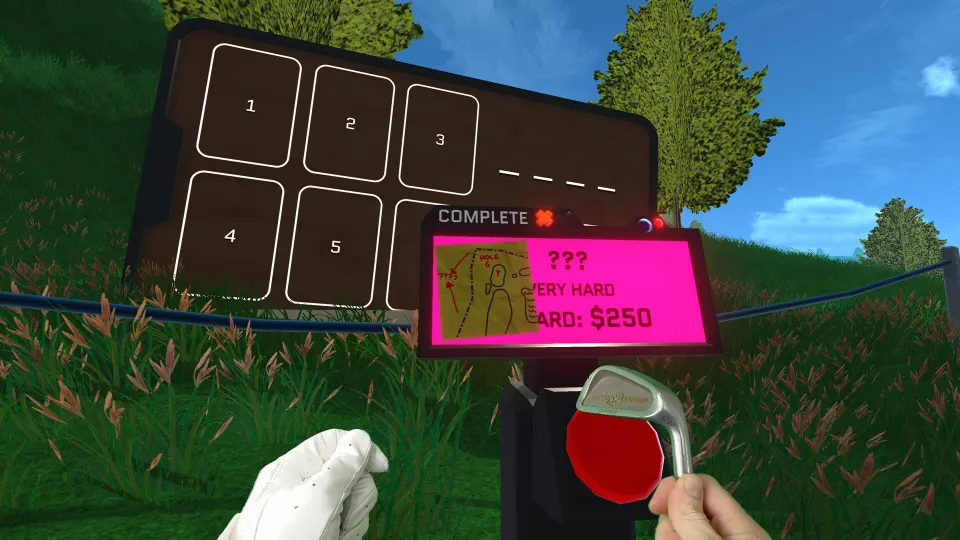
The game’s early challenges teach this rhythm. You may need to strike a hidden gong, damage signs, land in a bunker, or touch a green. These tasks can send you away from the usual route, but they also introduce landmarks that make later navigation easier.
| Situation | Recommended approach | Common mistake |
|---|---|---|
| You cannot see a bounty target | Walk to higher ground or around the obstacle | Blindly hitting toward the objective marker |
| A target is far away | Set up a clean line before adding power | Using maximum power without a landing plan |
| You are near a familiar flag | Use it as a reset point for navigation | Assuming it is the only place to play from |
| A shot misses badly | Reset and adjust one variable | Repeating the identical swing |
| You find an odd landmark | Test it with a controlled shot | Ignoring it because it is off the fairway |
When traveling, prioritize information over speed. A short walk can reveal that a target is behind a ridge, above you, or reachable from a different side. A difficult shot may become simple once you change your position.
Use this basic route-planning process:
- Read the bounty requirement closely and identify its actual condition.
- Locate a visible landmark near the likely target area.
- Walk until you can clearly see the target or a useful approach path.
- Choose a club and stance that fit the shot’s height and distance.
- Take a controlled attempt, then use the result to refine your next one.
The map rewards curiosity. A target that appears unreachable from a tee box may be easy from an adjacent hill, bunker edge, or open section of terrain.
Reading Terrain and Building Better Shot Lines
The course’s physics-based swing system makes terrain knowledge essential. A good line is not simply the straightest path to the target; it is the path that gives you room for an imperfect strike.
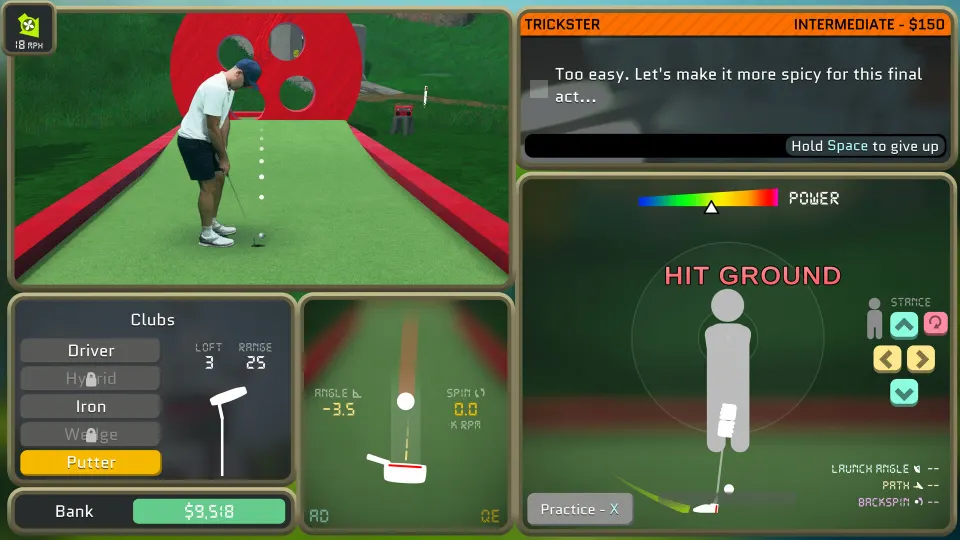
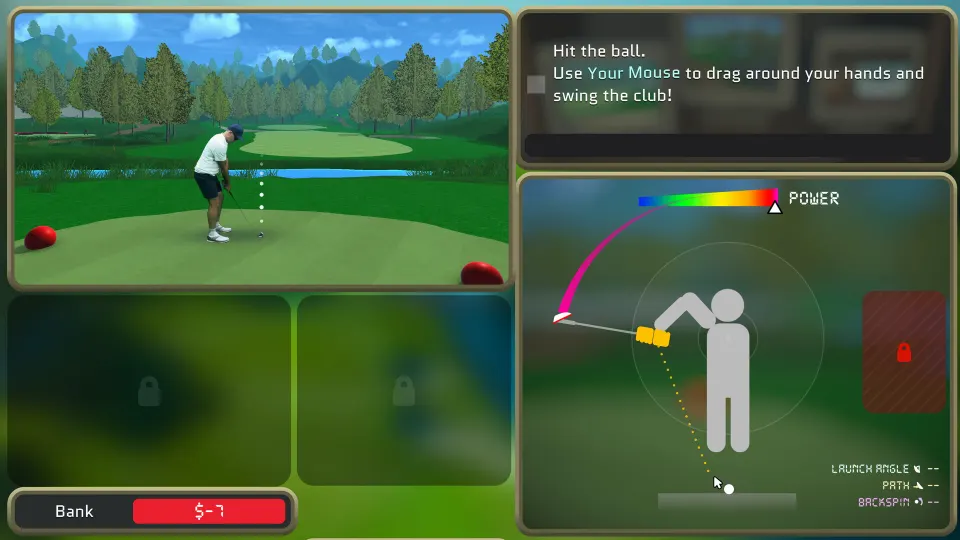
You control the club through physical movement while managing aim, stance, clubface position, and swing path. Small changes can create topped shots, thin contact, slices, draws, fades, or high shots. On a wide map, these tools are as useful for navigation as they are for scoring.
| Shot problem | Map-aware adjustment | Expected benefit |
|---|---|---|
| Ridge blocks the target | Move sideways or use more loft | Clears terrain instead of forcing a low line |
| Target sits beside an obstacle | Favor a conservative approach angle | Leaves a safer next shot |
| Wind pushes the ball | Start the line into the wind | Allows the ball to drift toward the target |
| Ball must reach a high object | Shift stance and create more lift | Improves vertical clearance |
| Long open distance | Build momentum with a full swing | Gains distance when misses are less dangerous |
Before attempting a difficult map target, inspect what happens after contact. Ask whether a miss will roll into rough terrain, fall behind an obstacle, or leave you unable to see the next shot. A safe miss is often more valuable than a perfect-looking line.
For short targets, use restrained swings. Controlled contact teaches you how the ball reacts to the ground and prevents the ball from crossing the map after a minor error. The quick reset option is especially useful for testing swing ideas without spending time retrieving a bad result.
For long targets, build up gradually. First confirm your aim with a moderate shot, then increase power only when you know the line is correct. Distance is valuable, but an uncontrolled drive can create a much harder recovery.
Curving shots are particularly useful around the map. A slice and fade can bend around one side of an obstacle, while a draw can bring the ball back from the other direction. Practice these techniques in open space before relying on them for a bounty.
Using the Map for Bounties, Secrets, and Practice
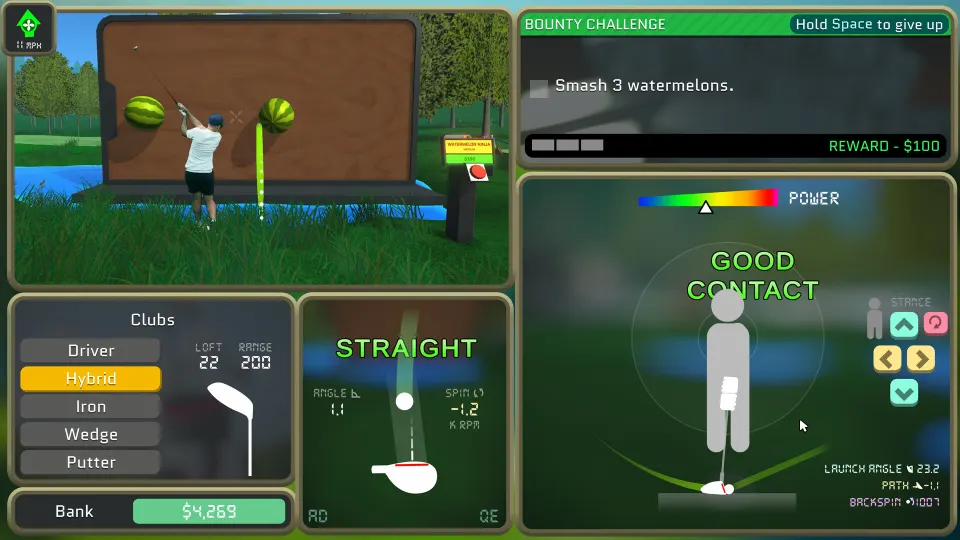
Bounties turn the map into a series of compact puzzles. There are more than 100 challenges, and many ask you to interact with the environment instead of simply finishing a golf hole.
The key is to separate the stated goal from the method. “Hit,” “finish,” “touch,” and “smash” require different setups. Hitting a target may only require a clean line, while completely smashing an object can require repeated contact or a more forceful shot.
| Bounty type | What to look for | Practical strategy |
|---|---|---|
| Target bounty | A distinct object or landmark | Find a direct line with manageable distance |
| Landing bounty | Green, bunker, or area boundary | Favor control over raw power |
| Distance bounty | Open ground and clear runout | Increase power in small increments |
| Precision bounty | Tight approach angle | Use a stable stance and conservative swing |
| Secret objective | Unusual structure or sightline | Explore beyond the obvious route |
The secret gong is a good example of how the map communicates objectives indirectly. Rather than treating it like a normal hole, look for unusual structures outside the main route. Sound feedback can confirm when your ball has interacted with something important.
If you become stuck, change the problem instead of just changing power. Try a new angle, walk to a different elevation, switch clubs, or approach from the opposite side. Most failed attempts provide useful information about reach, curve, or bounce.
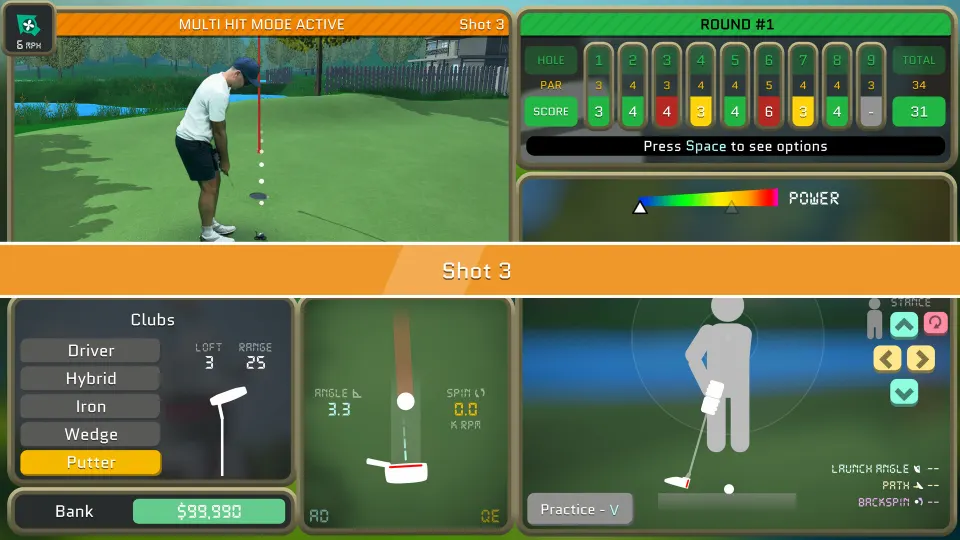
The bonus nine-hole mode is a valuable practice space. It offers a more traditional round where you can focus on getting the ball into each hole with fewer strokes. Use it to improve contact and club control before returning to unusual map challenges.
Difficulty modes also affect how you should approach exploration. Start at a setting where you can understand why each shot worked or failed. Once your swing feels consistent, higher difficulty adds a stronger test of planning and recovery.
FAQ
What is the normal golf game map?
The normal golf game map is the large central course used for the solo adventure. It contains standard golf areas, story progression, environmental targets, hidden objectives, and more than 100 bounties.
Is the map a sequence of separate courses?
No. The main adventure is built around exploring one large golf environment rather than following only a strict series of holes. You can often approach targets from multiple directions.
How do I find map objectives more easily?
Use major landmarks, climb or walk to elevated areas, and inspect unusual structures. If an objective sounds too strange for normal golf, it is probably meant to be found somewhere beyond the obvious fairway.
Can I practice without exploring the whole map?
Yes. The bonus nine-hole mode provides a more conventional golf round. It is useful for practicing swing control, scoring, and recovery shots without a bounty distracting you.
Is Normal Golf Game multiplayer?
The released game is designed as a single-player experience. Community discussions about multiplayer mods refer to unofficial projects, not an official multiplayer mode.